
Pre-cut film is cut by a machine to a template. Hand-cut film is cut on your car, by hand, from a bulk roll. Both use the same urethane. The difference is how much of each panel ends up covered, and what the edge looks like afterwards.
To be clear about what pre-cut can and cannot do: pre-cut PPF absolutely can be wrapped at the edges. A pattern can be adjusted, or extended with extra material, so the film tucks around the panel edge like a hand cut one. Shops that use pre-cut are not cutting corners — they are using a method built to reduce film waste, keep material costs down and get cars through faster.
The real difference is flexibility and control. A pre-cut pattern fixes how much film goes on each panel before the car is even in the bay, and some patterns stop short of the edge deliberately, to use less material. Hand cutting puts that decision in front of the installer, panel by panel, so each one can be taken to the maximum coverage it will accept. On a luxury car, that control is the whole job.
The job of paint protection film is to convince you it is not there while it protects the car. On a Porsche, a BMW or a Mercedes, that is not a detail — it is the entire result. Film you can see has already failed at half its job.
What pre-cut (factory-cut) film actually is
Most shops install pre-cut film, sometimes called factory-cut or computer-cut. A plotter cuts the film to a template before the car is touched. The installer peels it, wets it, lays it down and squeegees it out.
There are sound reasons for the method, and they are commercial rather than careless. A plotters cuts only what the panel needs, so very little film is wasted. Material cost drops. Installation is quicker, and a shop can turn more cars around. Some patterns are drawn to stop short of the panel edge specifically to use less film still — a few millimetres off the perimeter, on every panel, adds up across a roll.
None of that makes pre-cut incapable of a wrapped edge. A pattern can be adjusted, or extended with additional material, so the installer can still wrap and tuck the film around the panel edge where the vehicle's design permits. Plenty of shops do exactly that, and the result can be very good.
What that means in practice is a question of what the pattern does at the edge, and who decided it.
A standard pattern is cut to roughly the panel size, or deliberately inside it to save film. Film cut to hang over the edge would crease as it goes down, so the template resolves the perimeter before the installer touches the car. Laid as delivered, that leaves an edge sitting on the paint rather than tucked under it — visible as a fine line along the perimeter, collecting polish and road film, ageing differently from the paint beside it.
That is a default, not a limit. The installer can extend the pattern with extra material, or adjust it, and wrap the edge — and many do. But it is something the installer has to choose to add, on each panel, rather than something the method hands them by default. And a pattern cannot know about your particular car: two cars of the same model and year can have different panel gaps after a repair, and the template was drawn from one car, once.
What hand cutting is
Hand cutting starts from a bulk roll — a plain sheet of film — and the installer cuts it on the vehicle. Not on a bench, not from a template: on the car, following the actual panel in front of them, working the film into the shut lines and wrapping the excess around the edge before trimming.
What hand cutting buys is control over how much film each panel receives. There is no template deciding the perimeter in advance and no material budget dictating where the film stops. The installer measures, cuts to the maximum the panel will take, and wraps the excess around the edge and underneath — so the panel is covered as completely as its design allows, and the edge of the film is hidden behind it rather than sitting on top of it.
That per-panel judgement is the product. It is the difference between a car built to a standard pattern and a car where each panel was individually considered — and it also handles the places a pattern is weakest, because a pattern can only cover what somebody has already drawn. Bumper vents, parking sensors, headlight washers, the compound curves around a Cayenne or an X5 bumper, the shrink needed around a mirror housing, the odd shut line on a repaired car: every one of those is somewhere a hand cut can simply keep going.
Where the panel design itself will not accept a wrap — a sharp return, a trim gap, a seam that has nowhere to tuck — neither method can wrap it. The difference is that hand cutting takes every panel as far as it will go rather than stopping at a standardised line.
The edge, side by side
| What you are comparing | Pre-cut / factory-cut | Hand-cut |
|---|---|---|
| Where the film is cut | On a plotter, from a template, before the car arrives | On the car, by hand, from a bulk roll |
| What drives the pattern | Film waste and material cost — some patterns stop short of the edge to use less | Maximum coverage — film is cut to what the panel will take, not to a budget |
| Can the edge be wrapped? | Yes. The pattern can be adjusted or extended with extra material and tucked around the edge | Yes — wrapped as standard, on every panel the design allows |
| Who decides the coverage | The template, resolved before the car is in the bay | The installer, panel by panel, on your car |
| Panel edge, as usually delivered | Often stops on the paint, leaving a visible line — unless the installer extends it | Wrapped under the edge, so there is no line to see |
| Bumper vents, sensors, washers | Covered to the extent the drawing resolves them | Fitted and trimmed to the actual panel in front of the installer |
| Time and material | Faster, and less film used | Slower, and more film used |
| Skill required | Trained and repeatable | Considerably higher |
Where the film is cut
What drives the pattern
Can the edge be wrapped?
Who decides the coverage
Panel edge, as usually delivered
Bumper vents, sensors, washers
Time and material
Skill required
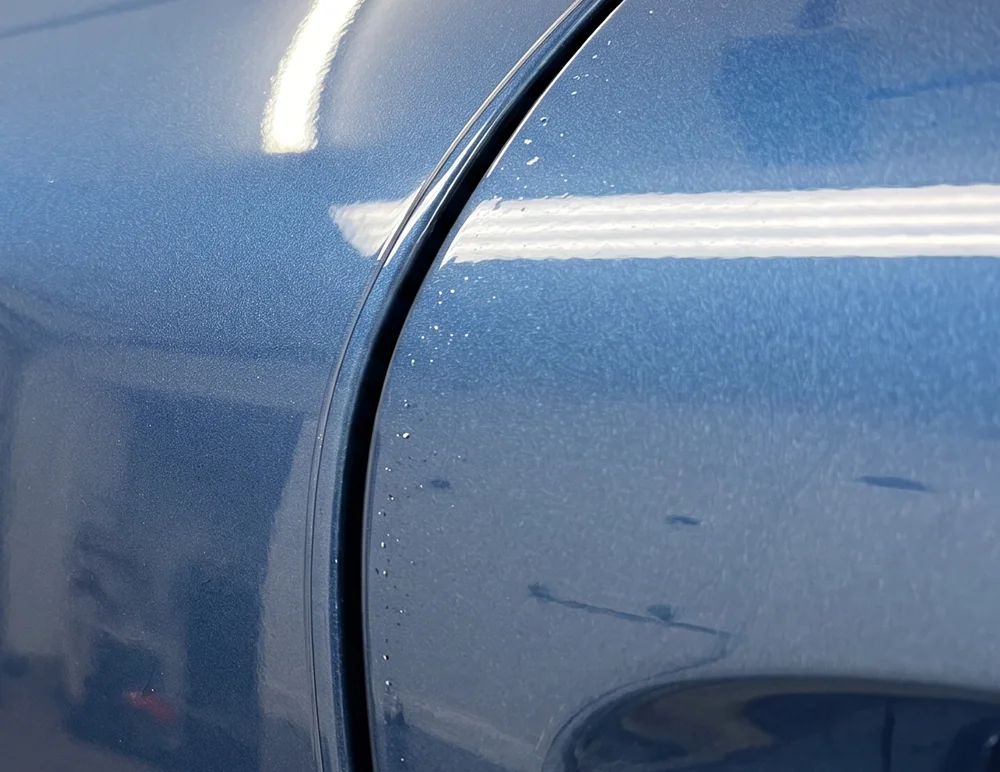
From ten feet away you cannot tell. Up close, in sunlight, on a light-coloured car especially, the edge is the first thing that gives it away — a fine grey line following the shut lines, holding a little dirt, catching the light differently from the paint beside it.
Why it matters more on a luxury car
On a daily driver that lives outside and gets parked at the shop, a visible edge line is a fair trade for a lower price and a faster turnaround. Nobody is crouching at the wheel arch.
A Porsche, a BMW or a Mercedes is a different set of expectations. It was bought for how it looks. The paint is the most expensive surface most owners will ever own, and it is the thing they notice every time they walk up to the car.
So the calculation changes. If the film is visible, the car has been made worse in order to be protected — which is the wrong trade at any price. Protection that announces itself has failed at half the job it was hired for.
This is where pre-cut and hand-cut stop being a matter of taste:
- Where a standard pattern is used, the edge is visible by design. Not because the installer was careless — because that pattern stops on the paint. A wrap variant avoids it, if one exists for the panel and the installer used it.
- An edge collects contamination. Polish, wax, shampoo residue and road film all gather in that line and need picking out at every wash.
- It cannot be polished around. On a car that gets machine polished, an edge is something to work carefully around, and a place where a pad can catch.
- It ages differently from the paint. Over years, the boundary between film and bare paint becomes more obvious, not less.
Hand-wrapped edges remove the question entirely. There is no line to see, nothing to clean out of it, and no boundary to age. The panel is simply covered, and the film reads as paint.
The skill involved
Pre-cut film is designed to make installation repeatable. Follow the pattern, squeegee it out, done. That is why it spread — a shop can train an installer on it in weeks, and the result is consistent because the template does the hard thinking.
Hand cutting is master-level work. Not because there is a certificate for it — because the margin for error is a blade's depth away from someone's paint, and there is no template to hide behind. Nothing is pre-decided. The installer:
- Reads each panel and decides where the film needs to stretch and where it must not
- Cuts a freehand line around curves, vents and sensor cut-outs without scoring the paint underneath
- Wraps the edge far enough to hide it and not so far it lifts later
- Manages adhesive tack on complex shapes, where the film wants to bridge rather than follow the surface
- Works cleanly enough that the finished panel looks untouched
Scoring the paint is the risk. A blade that goes a fraction too deep while trimming on the car leaves a line in the clear coat that cannot be polished out — so hand cutting demands a level of blade control that only comes from repetition on real cars.
That is the honest reason most shops do not offer it. It takes years of full-time work to become masterful at it, and it takes far longer per car. It is not that pre-cut is a shortcut taken carelessly — it is that hand cutting is a genuinely higher order of skill, and a shop only offers it if it has someone who has actually put in the time to master it.
What to ask any installer
These questions are answerable, and the answers are checkable on a finished car:
- "Is the film hand-cut from bulk, or pre-cut from a plotter?" A straight answer either way is fine. The problem is an installer who is vague.
- "Are the edges wrapped?" Wrapped means the film goes around the panel edge. If the answer is "we cut to the edge," the film ends on the paint.
- "Can I see a finished car up close — a light-coloured one?" Look along the bonnet edge and around the wheel arches in daylight. A wrapped edge has no line.
- "What happens at the shut lines on the doors?" The doors are where a pre-cut pattern is most obvious, because the edge sits right where you look every time you get in.
Getting it done in Philadelphia
Every paint protection film job at Luxury Detailing Auto Spa is hand-cut from bulk roll, on the car. Not one package, not on request — the method, on every PPF installation. That is a deliberate choice to prioritise complete coverage and properly wrapped edges wherever the panel design allows, rather than being limited by a standard pre-cut template.
The shop does most of its film work on Porsche, BMW and Mercedes-Benz, installed indoors in a climate-controlled studio in Northeast Philadelphia — which matters for this specific job, because film laid in a cold or dusty bay picks up contamination that no amount of skill can squeegee out afterwards.
See the PPF service page for coverage options and starting prices, or read what PPF costs in Philadelphia before you call.
Installation and film quality are separate things and both matter. A poor film will yellow, crack or lift long before a good one, however carefully it was fitted — and no edge wrapping rescues it. An excellent film fitted over a pattern with exposed edges will last, and still show a line you notice every day. What you want is both: a film worth wrapping, and an installer who wraps it.
Common questions
Is hand-cut PPF better than pre-cut PPF?
Not better in every respect — pre-cut uses less film, costs less in material and installs faster, and a pattern can be adjusted or extended so the edges are wrapped. The difference is flexibility: hand cutting lets the installer decide how much film each panel gets, taking every panel to the maximum coverage and wrapped edge its design will accept, rather than working to a standardised template. For a car where finish quality is the priority, that control is worth the extra time and cost.
Why does pre-cut film sometimes leave a gap at the edge?
Because some patterns are drawn to stop short of the panel edge deliberately, to use less film — a few millimetres off the perimeter on every panel adds up across a roll. It is a material-cost decision, not a capability limit. The pattern can be adjusted or extended with extra material and wrapped, and many installers do exactly that. Where it is not done, the result is an edge sitting on the paint rather than tucked underneath it.
Do all PPF shops hand cut?
No. Most use pre-cut patterns, because a plotter cuts only what each panel needs, so film waste and material cost stay low and cars get through faster. Many of those shops adjust or extend the pattern and wrap the edges, and get a good result. Hand cutting from bulk film uses more material and takes years to become reliable at, so it is less common, slower and usually costs more — which is why it is chosen where coverage and finish matter more than material economy.
Is a visible edge on PPF a big deal?
On a daily driver, it is a reasonable trade for a lower price. On a luxury car it is the main thing that gives the film away — the edge collects polish and dirt, catches the light differently from the paint, and becomes more obvious as it ages. If you bought the car for how it looks, a visible edge works against that.
Does hand cutting risk damaging the paint?
It can, which is why it requires real skill. Trimming film on the car means a blade runs close to the paint, and a cut a fraction too deep leaves a line in the clear coat that cannot be polished out. That blade control comes from repetition on real cars, not from a course.
How much longer does hand cutting take?
Substantially longer than a pre-cut install on the same car, because every panel is fitted and trimmed individually rather than laid from a template. It is one of the reasons a hand-cut quote is higher than a pre-cut one for the same coverage.