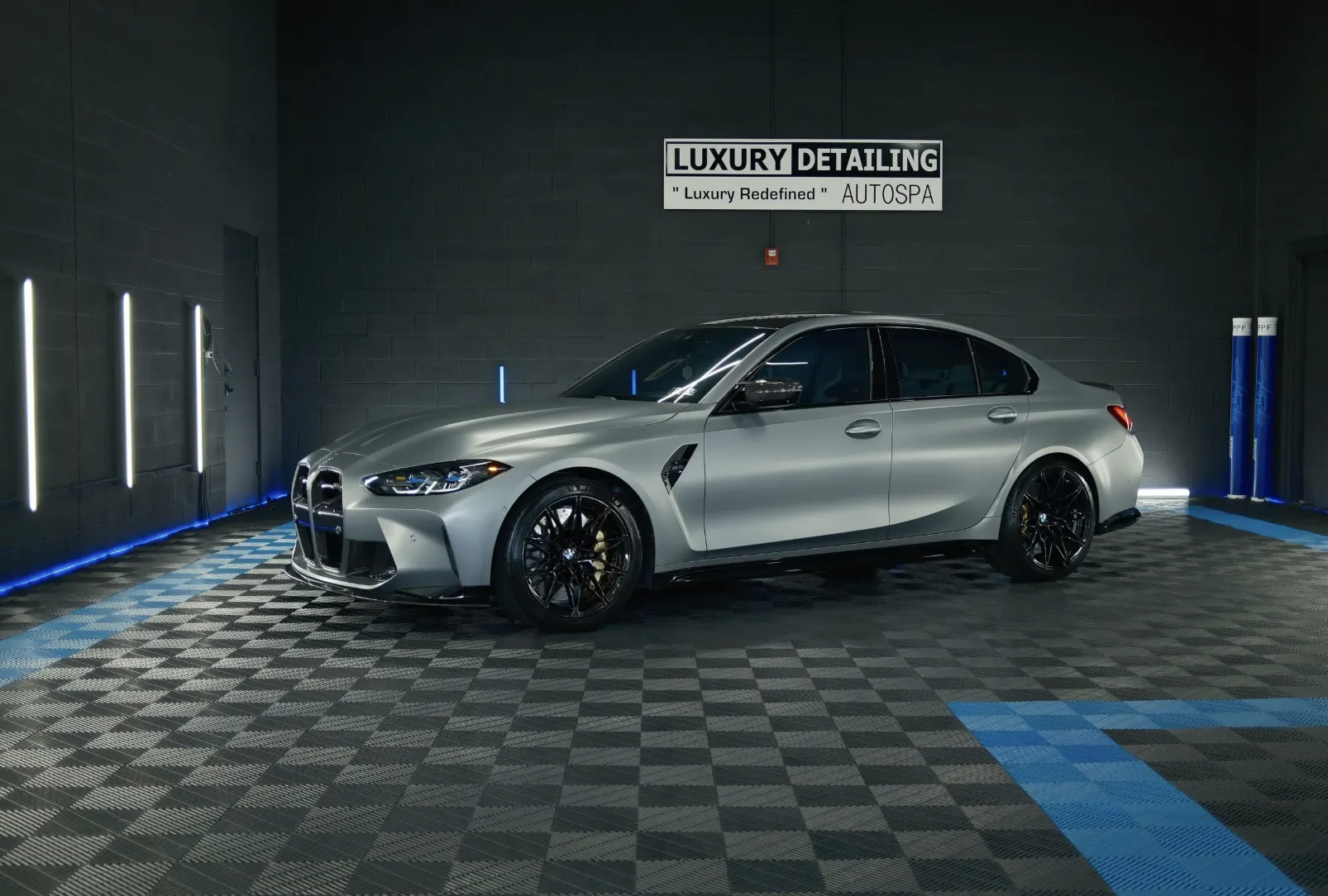
Judge the edge, not the shine. Every shop can make film look good from three metres away on the day you collect the car. What separates a careful install from a quick one is what happened at the perimeter of each panel — whether the film was wrapped around the edge and hidden underneath, or cut to stop on the paint and leave a line.
Ask for a finished car to inspect, in daylight, before you book. A shop that will not show you one is telling you something. Everything else on this page is what to do once you are standing in front of it.
The five-minute inspection
Ask if you can look at a completed car — ideally a light-coloured one, because pale paint shows every edge and every trapped speck and dark paint hides both. Then do this, in this order:
- Run a fingernail gently along the bonnet edge. If the film wraps around and under, you meet smooth paint or nothing at all. If it stops on the surface, you feel a step, and that step is a line of bare paint where dirt and polish collect.
- Look along the wheel arches from a crouch. Arches are shaped and heavily curved, which is where a pattern most often stops short. Sight along the arch in the light — a wrapped edge disappears, an unwrapped one shows as a faint grey line.
- Open a door and look at the shut line. An edge sitting inside the door jamb catches the light and holds wax. This is the area you look at every single time you get in the car.
- Look across the bonnet at a low angle, into the light. This reveals two things at once: contamination trapped under the film (small specks and hairs) and any lifting or bridging where the film crosses a crease.
- Check the bumper around the vents, sensors and washers. Each one is a hole somebody had to cut. Look for ragged edges, for film overlapping the sensor aperture, and for a cut that wandered.
- Look for a cut line in the paint. This is the one that cannot be fixed. Where film is trimmed on the car, a blade that goes a fraction too deep leaves a score in the clear coat that no amount of polishing will remove. Tilt the panel in the light and look for straight lines that are not meant to be there.
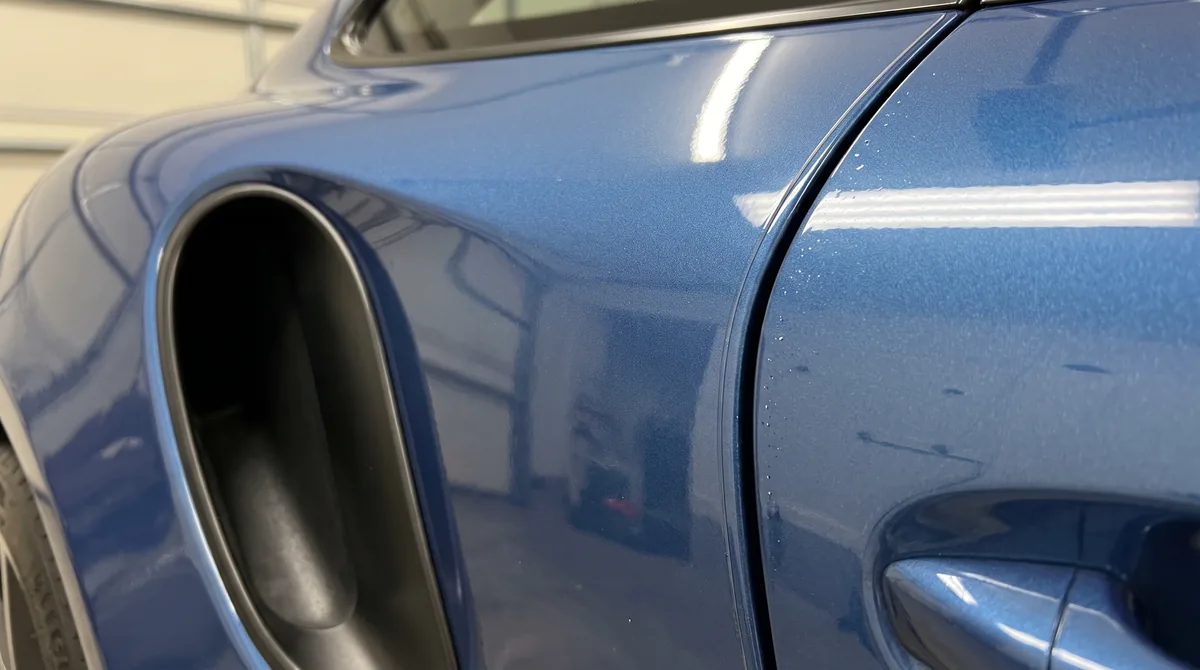
None of this needs equipment. It needs daylight, about five minutes, and the willingness to look closely at something you are about to pay for.
Questions to ask before you book
All of these have real answers, and none of them are rude to ask. Vague answers are themselves information.
| Ask | Why it matters |
|---|---|
| Is the film hand-cut from bulk, or pre-cut from a plotter? | Both can produce a wrapped edge. Hand cutting means the installer decides coverage panel by panel; pre-cut depends on whether a wrap variant exists for that panel. A straight answer either way is fine. |
| Are the edges wrapped? | Wrapped means the film goes around the panel edge and tucks underneath. "We cut to the edge" means the film ends on the paint. |
| Who quotes it, and who installs it? | If they are different people, the person pricing the job is not the person who has to make it work. That is where surprises come from. |
| Is it installed indoors? | Dust and wind are the enemy. Film laid outside or in a busy workshop picks up contamination that cannot be squeegeed out afterwards, and it is trapped permanently. |
| Is the space climate-controlled? | Film behaves differently cold. A cold bay makes film stiff and edges less likely to stay wrapped, and some adhesives will not bond properly below a certain temperature. |
| What happens if the paint needs work first? | Film locks in whatever is underneath it. Swirls and scratches under film stay there, and some shops will film over them rather than tell you. |
| What exactly does the warranty cover? | Ask separately about the film and the installation. They are often different parties. A warranty on the material does not cover a lifting edge caused by fitting. |
| Can I see a finished car? | The whole inspection above depends on it. |
Film quality and installation quality are separate things
Buyers often treat these as one decision. They are not, and conflating them leads to bad choices in both directions.
Installation quality decides what you see. A wrapped edge, a clean cut around a sensor, film that follows a crease instead of bridging it, no contamination underneath. A brilliant film fitted carelessly still shows a line at every panel edge, and that line is what you look at every day.
Film quality decides how long it lasts and how it behaves. Cheap film yellows, cracks, or lifts at the edges long before a good film does — and no amount of skilled fitting rescues it. A poor film installed beautifully is a beautiful install that fails in three years.
So ask about both, separately, and be suspicious of a quote that only talks about one. A quote that leads on price alone is usually a cheaper film, a quicker method, or both.
The method question — hand-cut versus pre-cut — is covered in detail in hand-cut vs pre-cut PPF, including the honest trade in both directions.
Red flags
- No finished car available to inspect. Either there is not one, or they would rather you did not look closely.
- A price far below everyone else. Film, time and skill all cost money. A quote well under the market is under on one of them.
- Filming over uncorrected paint without mentioning it. Ask directly whether the paint needs correcting first and see how they answer.
- Vague warranty language. "Fully guaranteed" means nothing. Ask what is covered, by whom, for how long, and what voids it.
- Installed outdoors, or in a bay that shares space with other work. Dust is permanent once it is under the film.
- Pressure to book before you have seen anything. Film is not a same-day impulse purchase and a shop that treats it as one is selling, not advising.
- Nobody will name the film. You are entitled to know what is going on your car and what its warranty is.
What a good install looks like
- Nothing to see at the panel edges. That is the whole test. If you have to hunt for the edge, it is done properly.
- No contamination under the film. Look across the panel into the light — it should be clean, not speckled.
- Sharp, clean cuts around vents, sensors and washers. These are freehand decisions, and they show the level of the person doing them.
- The film follows the body lines. No bridging across a crease, no lifting at a compound curve.
- The paint underneath is better than before, not just filmed. If the car needed correction, it was done.
- It was done indoors, in a controlled space. Ask to see the bay while you are there — most shops will show you.
- You were told which panels could not be wrapped. Every car has one or two where the design will not accept it. A shop that admits this on their own car is being straight with you about yours.
That last point is worth dwelling on. Any installer who claims every panel on every car can be wrapped perfectly is either not inspecting closely or not telling you the truth. A good one will walk you round a finished car and point out the two places the design fought back.
If you are looking locally
This page is written to be used on any shop, including ours — and the checklist is deliberately one we are willing to be held to. If you want to apply it to us: every film job at Luxury Detailing Auto Spa is hand-cut from bulk roll and installed indoors in a climate-controlled studio in Northeast Philadelphia, mostly on Porsche, BMW and Mercedes-Benz. Emad quotes and Emad installs.
You are welcome to come and look at a finished car before deciding, and to ask which panels on your own car will not take a wrapped edge. If the answer puts you off, that is a better outcome than finding out afterwards.
Common questions
How can I tell if PPF was installed well?
Look at the panel edges. A good install wraps the film around the edge and under the panel so there is nothing to see; a rushed one leaves the film stopping on the paint, which shows as a faint line that collects dirt and polish. Check the bonnet edge, the wheel arches and the door shut lines in daylight. Also look across the bonnet into the light for contamination trapped under the film.
Should I ask to see a finished car before booking PPF?
Yes, and it is the single most useful thing you can do. Ask for a completed car, ideally a light-coloured one because pale paint shows every edge. A shop that will not show you one is telling you something. Five minutes with your eyes and a fingernail along the bonnet edge tells you more than any brochure.
Is a wrapped edge worth paying more for?
On a car you care about how it looks, usually yes. A wrapped edge leaves no line to catch the light, nothing for polish and wax to collect in, and no boundary that ages differently from the paint. On a work vehicle, film cut to the panel edge is a reasonable trade for a lower price. It is a judgement about what the car is for.
What is the difference between film warranty and installation warranty?
They are usually different things and sometimes different parties. The film warranty covers the material — yellowing, cracking, delamination. The installation warranty covers the fitting — lifting edges, bubbling, contamination. Ask about both separately, because a material warranty will not cover a lifting edge caused by how the film was applied.
Does PPF hide paint defects or do I need correction first?
It hides nothing. Film locks in whatever is underneath it, so swirls, scratches and oxidation stay visible through the film and are now harder to fix because they are under a layer. If the paint needs correcting, that should happen before filming and should be quoted separately rather than skipped.
How long does PPF installation take?
It depends on coverage and the car. A full front is typically about a day; a full body is several days. Anyone quoting a full body in a single day is either rushing the work or not doing the panel-by-panel fitting it requires. Ask what the car is actually booked in for.