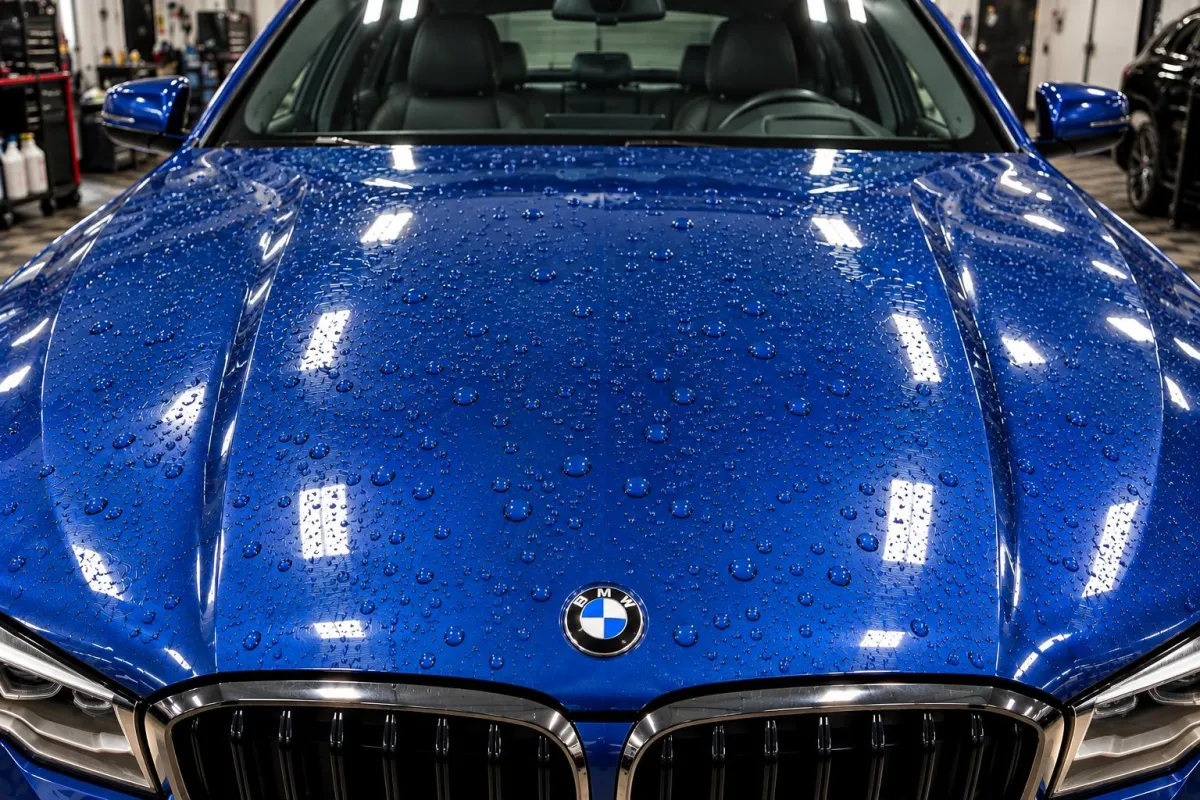
A professional ceramic coating, a ceramic sealant and a ceramic wax are three different product categories that share one word. A coating is a liquid applied to prepared paint that cures into a thin film and stays for years. A sealant is a synthetic polymer that sits on the surface for months. A wax is a wax or sealant base with ceramic additives, measured in weeks to a few months. On the last two, “ceramic” describes an ingredient; on a coating, it describes the product.
What a professional ceramic coating is
A ceramic coating is a liquid product applied to prepared clear coat that cures into a thin, glass-like film on top of the paint. The film is measured in microns — far thinner than the clear coat beneath it. It is not a second layer of clear coat and adds no measurable film build.
What turns it from a liquid into a surface is curing, not drying. The carrier solvents come off and the film sets — the stage where the installer still has a working window to level it — and over the following hours and days it continues to cure and cross-link. The exact chemistry varies: many coatings are built on silicon-based resins, and some bond chemically to the clear coat while others form a dense film on top of it. The data sheet is the authority on any individual product.
The finished layer changes the surface energy of the paint. Water beads and sheets off rather than sitting flat, and contamination — road film, salt, bird droppings, tree sap, industrial fallout — has less to grip. That makes the car easier to wash and easier to rinse before anything etches. Many coatings also add a degree of chemical and UV resistance and help the gloss hold up; how much depends on the formulation, the number of coats and the maintenance afterwards.
The limits matter as much as the benefits. A coating is not permanent, not a substitute for clear coat, and does not stop stone chips or scratches: a film measured in microns will not absorb an impact and can still be marked by a careless wash. It needs washing, it wears gradually, and eventually it is polished off or coated over again.
Coatings, ceramic sealants and ceramic waxes
The three categories differ in what they are made of, whether they form a film that becomes the surface or sit on top of it, and how long they last.
A ceramic coating is the product described above. It is applied panel by panel by an installer in a controlled space, and levelled inside the product’s working window before it sets. Once cured it does not wash or buff off; removal generally means machine polishing or another suitable method. Durability is measured in years — commonly two to five, longer with some formulations, and dependent on preparation, coats and maintenance.
A ceramic sealant is a liquid synthetic polymer product with ceramic content, designed to form a film on the surface rather than cure into it. It is workable for longer and far more forgiving than a coating, and it is levelled and buffed as part of the job. Durability is measured in months.
A ceramic wax is a wax or polymer base with ceramic — typically silica-based — additives blended in. It sits on the surface, is spread and buffed as part of the job, and is reapplied periodically. The ceramic content typically improves beading and extends durability versus a plain wax, which is why formulators use it. Durability is measured in weeks to a few months.
| Category | What it is | Typical durability | How it is applied, in principle |
|---|---|---|---|
| Ceramic coating | A liquid that cures into a thin cross-linked film on prepared clear coat | Years — commonly 2 to 5+, depending on formulation, coats and care | Panel by panel, by an installer, in a controlled space, levelled inside a working window before it sets |
| Ceramic sealant | A synthetic polymer liquid with ceramic content that forms a film on the surface | Months | Wiped on and levelled as part of the job; sits on the paint rather than curing into it |
| Ceramic wax | A wax or polymer base with ceramic additives blended in | Weeks to a few months | Spread and buffed as part of the job; reapplied periodically |
The categories overlap at the edges: some products sold as ceramic waxes behave like sealants, and some sprayable products sold as coatings are really toppers. That is why the category, not the word on the bottle, is what to establish first.
Why “ceramic” on a label proves little
“Ceramic” is not a regulated specification. In consumer products it most often means the formulation contains a ceramic or silica-based additive; it does not define the class of product, the film thickness, the cure behaviour or the durability. No standard governs which products may use the word, so a bottle, a spray and a professionally installed coating can all carry it while being entirely different things.
The distinction is between a product that contains an ingredient and one that is made of it. Ceramic particles dispersed in a wax or sealant can genuinely improve it — better beading, longer life than the plain version — but they do not turn it into a coating, because it still sits on the surface, wears and is reapplied. The additive changes the performance of the category, not the category.
This is where most of the confusion comes from. Someone buys a product on the strength of the word, expects the years a coating delivers, gets the weeks a wax delivers, and concludes that ceramic protection is a con. The opposite error is just as common: someone whose only experience of “ceramic” is a spray topper dismisses the whole category, coatings included. Both mistakes come from the label rather than from the products.
The label is also a poor guide to professional or consumer grade. Professional coatings are not automatically stronger or longer-lived than consumer ones, and higher solids do not guarantee better performance. Durability and working time depend on the individual formulation. What a studio provides is the preparation and controlled installation the product needs to perform as designed.
Formulation, durability and protection
Formulation. Waxes are built on natural waxes, oils or polymer bases with solvents and additives. Sealants are synthetic polymers. Coatings are built on silicon-based resin chemistry designed to cross-link as they cure, and the chemistry differs by product. These are category-level generalisations; the data sheet describes any actual formulation.
Durability. The gap is an order of magnitude, not a margin: weeks to a few months for a ceramic wax, months for a sealant, years for a coating. The bands are typical rather than guaranteed, and the spread inside each is wide — a well-maintained product near the top of its band can outlast a neglected one near the bottom.
Performance. Beading, ease of cleaning, chemical resistance and UV resistance all tend to scale with the category, because they follow from how long the film stays on the surface and how tightly it is bound to it. “Tend to” is doing real work there: a strong sealant can outperform a weak coating on some measures, and a coating over unprepared paint can underperform a well-applied sealant. Category sets the ceiling; preparation and formulation decide where a car lands.
Protection. All three are chemical and surface protection. They resist water spotting, contamination bonding, UV exposure and chemical etching to different degrees, and they make washing easier. None is impact protection: a stone chip is a mechanical event, and the product that absorbs it is paint protection film, not a coating or a wax. The two are complementary, which is covered in PPF vs. ceramic coating.
Why preparation is the work
Most of a coating job is decided before the bottle is opened. Whatever is under the coating stays under it for as long as the coating lasts, so preparation is not a formality ahead of the work — it is the work, and the application is the last step of it.
Preparation means washing and decontaminating the paint, removing bonded contamination where it is present, and correcting the finish where it is needed. It means measuring paint thickness rather than judging it by eye: polishing removes clear coat, and a gauge reading tells an installer how much there is to work with and what is safe to remove. Thin paint cannot be identified by looking at it, and no responsible correction starts without a measurement.
It also means the environment. A coating needs a space where temperature and humidity can be held, dust is controlled, the panel can be inspected under a bright light at a low angle so a high spot is visible while it can still be levelled, and the car can stay dry through the early part of its cure. Those conditions have to hold over the whole car for the whole job — which is what a studio is for.
The benefit is the combination: a corrected finish under a film that makes the car easier to wash, keeps contamination from bonding and holds its gloss. The correction is what the eye sees; the coating is what keeps it that way and makes the upkeep cheaper in time.
Two warranties are involved and they cover different things. The workmanship warranty is the studio’s: it covers the preparation, the polishing and the application, and the quote states what it covers and for how long. The coating product may carry a separate manufacturer’s warranty, set and administered by the manufacturer; where one applies, its terms sit alongside the workmanship terms. Neither promises that every finish problem can be polished away — some defects sit in the paint underneath, and removing the coating does not remove them.
Common questions
Is ceramic wax the same as a ceramic coating?
No. A ceramic wax is a wax or polymer base with ceramic additives, measured in weeks to a few months before it is reapplied. A coating cures into a cross-linked film on prepared clear coat and lasts for years. They share a word, not a category.
Is a ceramic sealant the same as a ceramic coating?
No. A sealant forms a film on the surface and is measured in months. A coating cures into the surface and is measured in years.
How long does a professional ceramic coating last?
Commonly two to five years, and longer with some formulations. The rating assumes proper preparation and sensible washing afterwards. It is not permanent, and it does wear gradually.
Does a product with ceramic in the name protect like a coating?
Not in the way a coating does. Ceramic additives can improve a wax or sealant, but the product still sits on the surface, wears and is reapplied. That is a limit of the category, not a fault of a particular product.
Does a ceramic coating stop rock chips or scratches?
No. It is chemical and surface protection, measured in microns, and will not absorb an impact. Stone chips are what paint protection film is for.
Is professional-grade coating better than consumer-grade?
Not as a general rule. Performance and durability depend on the individual formulation. What a studio provides is the preparation, the controlled environment and the installation the product needs.
Does a coated car still need washing?
Yes. A coating makes washing easier and reduces how strongly contamination bonds, but it is not self-cleaning. Regular washing with a pH-neutral shampoo is part of what keeps it performing.
Where the work is done
Every coating we install is applied indoors, in a controlled space, to paint that has been prepared for it. Our studio is at 10065 Sandmeyer Ln, Suite W405, in Northeast Philadelphia, off Roosevelt Blvd — about 20 minutes from Bucks County, a short drive from I-95 and the Turnpike.
Coating packages start from $400 for 2-year, $800 for 3-year and $1,500 for 5-year, each including the wash, decontamination, panel wipe and the correction the paint actually needs. Our workmanship warranty covers our work; the coating product may carry a separate manufacturer’s warranty, set by the manufacturer and not by us.